In this guide ▾
Basilica di San Pietro is the Italian name of St. Peter’s Basilica, the great Renaissance church in Vatican City. You will see this name on Italian signs, official pages, maps and ticket vouchers, and it points to the same building that English guides call St. Peter’s. This page decodes the Italian names, explains the dome and the tomb below it, and shows how to plan a visit without confusion.
I’m Giulia Romano, and this is an independent visitor guide, not the official ticket office. I link every number or rule to a source so you can check the current detail, and my Vatican tickets online page compares the main ways to get in.
What Does Basilica di San Pietro Mean?
Basilica di San Pietro translates simply as the Basilica of Saint Peter. As Wikipedia gives it, the complete Italian title is Basilica Papale di San Pietro in Vaticano, meaning the Papal Basilica of Saint Peter in the Vatican. In Latin the church is called Basilica Sancti Petri.
A few related Italian words appear on the same signs. This small glossary shows how they line up with English.
| Italian | English | Where you meet it |
|---|---|---|
| Basilica di San Pietro | St. Peter’s Basilica | Signs, vouchers, official pages |
| Basilica Papale di San Pietro in Vaticano | Papal Basilica of Saint Peter in the Vatican | Formal title on Wikipedia |
| Piazza San Pietro | St. Peter’s Square | The address of the basilica on the map |
| Città del Vaticano | Vatican City | Postal address, 00120 |
If the English name is the one you know, my page on St Peter’s Basilica covers the same church from the visitor side.
 Want a closer look? Vatican Museums, Sistine Chapel & St. Peter's Basilica Tour, from $60See times →
Where Is the Basilica di San Pietro?
The Basilica di San Pietro sits inside Vatican City, an independent microstate enclosed by the city of Rome, Italy. Its address on Google Maps is Piazza San Pietro, 00120 Città del Vaticano.
 Book aheadVatican Museums, Sistine Chapel & St. Peter's Basilica TourCheck availability · from $60
Wikipedia places it west of the River Tiber, near the Janiculum Hill and Hadrian’s Mausoleum. The central dome dominates the skyline of Rome, so it is easy to spot from a distance. My page on the basilica in Vatican City explains how the church sits inside the state, and the page on St. Peter’s Basilica in Rome shows how it relates to the city around it.
Saint Peter’s Basilica
Basilica · ★ 4.8 · 185,703 Google reviews
Piazza San Pietro, 00120 Città del Vaticano, Vatican City
Opening hours
- Friday7 am–7:10 pm
- Monday7 am–7:10 pm
- Saturday7 am–7:10 pm
- Sunday7 am–7:10 pm
- Thursday7 am–7:10 pm
- Tuesday7 am–7:10 pm
- Wednesday7 am–7:10 pm
THE LOFT Colazione, Brunch & Pizza Dinner vicino San Pietro
Brunch restaurant · ★ 4.8 · 3,661 Google reviews
Via Leone IV, 34, 00192 Roma RM, Italy
Opening hours
- Friday8 am–11 pm
- Monday8 am–10 pm
- Saturday8 am–11 pm
- Sunday9 am–5 pm
- Thursday8 am–4 pm
- Tuesday8 am–4 pm
- Wednesday8 am–4 pm
 Skip the ticket line: Vatican Museums, Sistine Chapel & St. Peter's Basilica Tour, from $55Check dates →
Is the Basilica di San Pietro Free to Enter?
Entering the Basilica di San Pietro is free, according to one Google Maps reviewer who said you pay extra for the other sites. This fits how the official site is laid out: the church is the base visit, and the dome, the Necropolis, the Treasury Museum and guided tours are separate products you book.
“Do not miss this place for a FREE location! This is the most beautiful church I've ever been to. Once your through security and the main doors, you are truly hit by the size and artwork. We got there 645am and already there's a line but got in very quickly. If your just there for free visit, you can see most of it in 40mins. Pay extra for the other locations.”
Free does not mean fast. Everyone passes a security check, and the official dome FAQ states that security checks remain mandatory for all visitors. The same reviewer arrived at 6:45 am and still found a line, but said it moved quickly.
The Google Maps listing shows opening from 7 am to 7:10 pm daily. Treat that as an approximate window, because papal ceremonies and security needs change the schedule. My page on Basilica di San Pietro hours goes through the timing questions in more detail.
 Short on time? Vatican Museums, Sistine Chapel & St Peter's Basilica Tour, from $77Book a slot →
What Is the History Behind the Basilica di San Pietro?
The history of the Basilica di San Pietro starts with Old St. Peter’s Basilica, which the Roman emperor Constantine the Great built in the fourth century. Wikipedia says Pope Nicholas V and then Pope Julius II planned a replacement because the old church was ageing. Construction began on 18 April 1506 and was completed on 18 November 1626.
Several major designers shaped the result. Wikipedia names Donato Bramante, Michelangelo and Carlo Maderno as the principal designers, with the piazza and fittings by Gian Lorenzo Bernini. Wikidata lists Michelangelo, Giuliano da Sangallo and Donato Bramante as architects and gives the styles as Renaissance and baroque.
The church is regarded as one of the holiest Catholic shrines, according to Wikipedia. Catholic tradition holds that it is the burial site of Saint Peter, with his tomb directly below the high altar. It is also one of the Seven Pilgrim Churches of Rome.
 Prefer a guide? Rome: Vatican Museums, Sistine Chapel & Basilica Tour, from $71See tours →
Basilica di San Pietro by the Numbers
Basilica di San Pietro statistics below are drawn from Wikidata, and beside each one I note what it means for your visit.
- 11,000,000 visitors per year (2018 figure): expect crowds, so go early.
- 136.6 m tall: the dome is why the church is visible across Rome.
- 220 m long and 150 m wide: allow time even for a quick walk through the interior.
- Begun on 18 April 1506: the present church is more than five centuries old.
- Part of a UNESCO World Heritage Site: it is protected heritage, so the entry rules are strict.
- Vatican City covers 0.44 km²: the state is small, and the church and square take up much of it.
 Planning ahead? Vatican, Sistine Chapel & St. Peter's Skip-the-Line Tour, from $77Check availability →
How Was the Dome Built?
The dome was built in stages, according to the official site: Michelangelo conceived it and raised it as far as the drum. After his death, the architect Giacomo della Porta finished it, working alongside Domenico Fontana from 1588 to 1590. The site says the dome rose in just 22 months thanks to 800 labourers.
The dome is double-shelled and has a slender ogival shape. On 18 November 1593, a large gilded bronze sphere topped by the cross was placed on the spire of the lantern. The same official page notes that the inner dome of the lantern reaches 117 metres, while the cross at the top is over 133 metres high. You can read the full text on the official page about the dome.
The Mosaics Inside
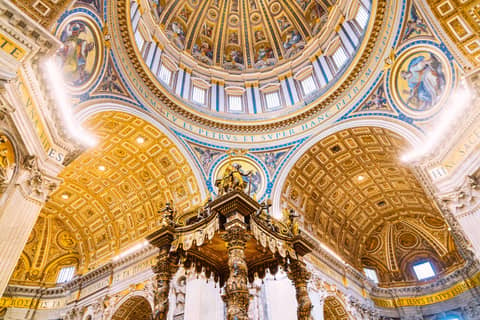
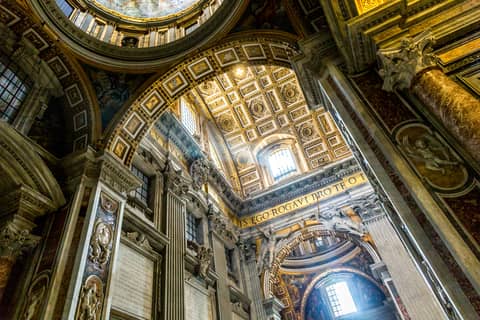
The dome mosaics were commissioned by Pope Clement VIII, and numerous mosaicists worked on them between 1598 and 1613. The surface of about 3000 square metres is divided by ribs into sixteen wedge-shaped compartments. A golden sky of stars forms the background.
Reading from top to bottom, the figures include the Eternal Father, seraphim, angels, cherubim, and the Redeemer with Saint John the Baptist, Our Lady, Saint Paul and the Apostles. On the frieze at the base, large blue letters on gold quote the words addressed to Peter in the Gospel of Matthew.
 Most booked this week: Rome: Vatican Museums, Sistine Chapel and Basilica Access, from $68See prices →
Can You Climb the Dome?
You can climb the dome, and the choice is a lift or stairs. According to the official dome booking page, each option includes access and a visit to the basilica with a Digital Audio Guide, plus a visit to the inner ring and the outer ring of the dome.
- With lift: a lift ride to the terrace level.
- With stairs: stairs to the terrace level.
The official FAQ says the lift only goes up to the terrace level. From the inner ring, visitors must climb 320 steps to reach the outer ring. It adds that the visit lasts about 1 hour on average and that the basilica entry is scheduled one hour before or after your dome time.
Only small personal bags are allowed on the climb, and the FAQ says there is no cloakroom or luggage storage. Plan to leave large backpacks at your hotel.
Best value pick: Vatican Museums, Sistine Chapel & St. Peter's Basilica Tour, from $60View dates →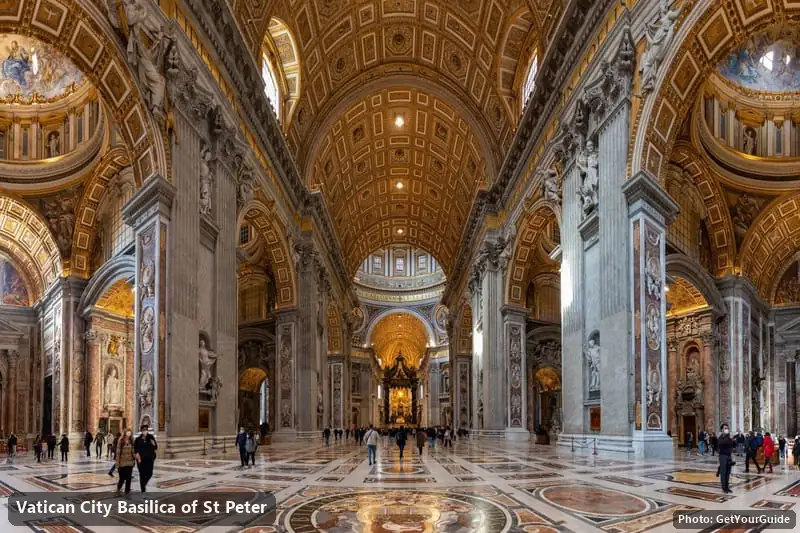
What Is Under the Basilica di San Pietro?
Under the Basilica di San Pietro lies the Vatican Necropolis, beneath the central nave. Wikipedia describes it as a complex of mausoleums dating from about AD 130 to AD 500, and says Saint Peter’s tomb is a site under the basilica that includes several graves and a structure that Vatican authorities say was built to memorialize his grave location.
The official page on the Necropolis calls it a place that was inaccessible and untouched for sixteen centuries beneath the floor of the Constantinian basilica. It is booked as a reservation request, not a walk-in visit. Read the details on the official Necropolis page before you plan around it.
Wikipedia also explains that Pope Pius XII stated in 1950 that none of the bones found could be confirmed to be Saint Peter’s with absolute certainty. In 1968, Pope Paul VI stated that relics of the saint had been identified in a manner considered to be convincing. My page on the Vatican and its St. Peter’s Basilica puts the church in the wider context.
Going with family? Vatican Museums, Sistine Chapel & St. Peter's Basilica Tour, from $55Compare tickets →What Do You See Before You Enter?
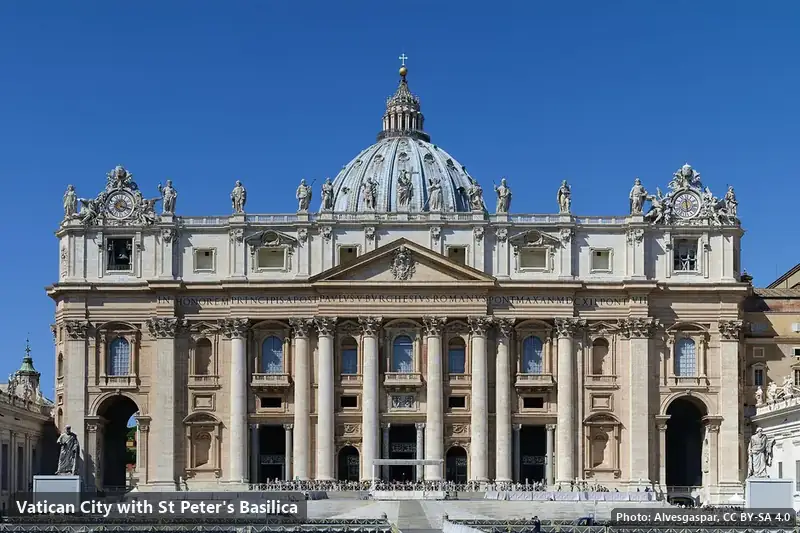
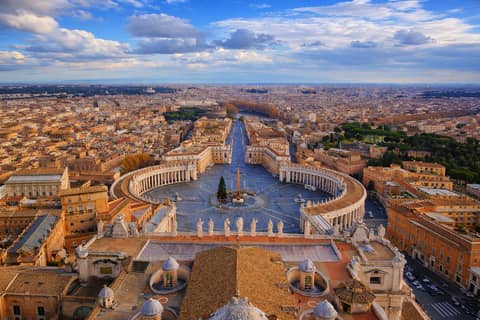
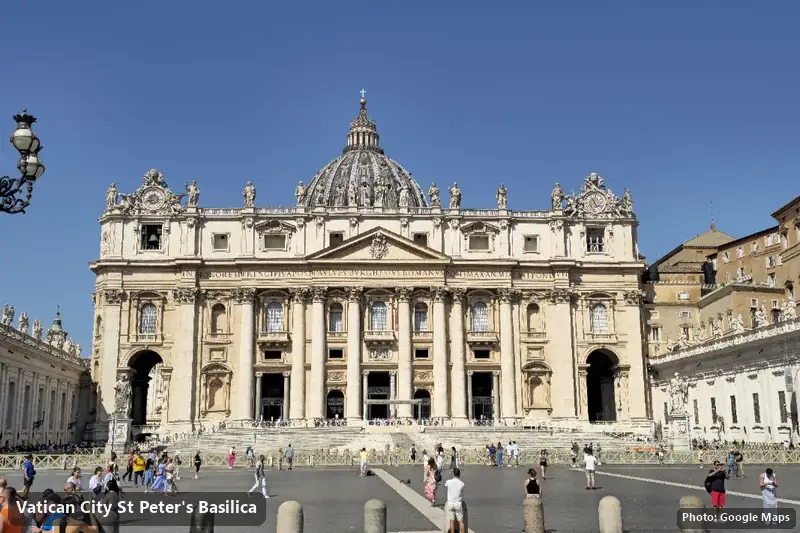
Before you enter the basilica, you cross St. Peter’s Square, a forecourt in two sections ringed by tall colonnades, according to Wikipedia. The first space is oval and the second is trapezoidal. The facade has a giant order of columns and stretches across the end of the square, approached by steps where two statues of Saints Peter and Paul stand, each 5.55 metres tall.
Security screening takes place in the square, and the official dome FAQ says visitors with online tickets must follow an assigned route, named Sobieski or Lambertini, shown in the email with the QR codes. So look at your voucher before you leave the hotel, not at the gate.
Inside, the plan is cruciform, with an elongated nave in the Latin cross form. Wikipedia notes that the early designs were for a centrally planned structure, and you can still see that idea in the architecture. Wikidata gives the dimensions as about 220 m long and 150 m wide, which explains why even a quick walk through takes time.
The Treasury Museum
The Treasury Museum is listed on the official site as a separate visit. It presents a renewed itinerary of sacred artworks, liturgical furnishings and artistic treasures. If you are short on time, you can skip it and still see the main church. If you enjoy sacred art, add it when you book.
Want a closer look? Vatican Museums, Sistine Chapel & St Peter's Basilica Tour, from $77See times →
What Should You Wear to the Basilica?
What to wear to the basilica is clothing suited to a place of worship, with shoulders and knees covered. The official dome FAQ states this for the dome climb, and the same standard is the safe choice for the church. That means tank tops and short skirts are a poor choice, while long trousers and a light scarf or jacket work well.
Pack light as well. The official FAQ says large backpacks, trolleys and bulky luggage are not allowed on the dome. A small bag also moves through screening faster, which helps on busy mornings.
Skip the ticket line: Rome: Vatican Museums, Sistine Chapel & Basilica Tour, from $71Check dates →How Do You Get a Ticket or a Guide?
A timed ticket or guide is easy to arrange, and the official FAQ explains the process. After booking you receive a voucher email, then an email with QR codes for every participant, and the QR codes are mandatory at entry. If you do not receive them within 30 minutes of booking, the FAQ says to check spam and write to the booking address on the site.
Many travelers prefer a tour that combines the basilica with the museums, because it handles the logistics. The tours below include the Vatican Museums and the Sistine Chapel, and several treat the basilica as part of the booking or as an option.
Vatican Museums, Sistine Chapel & St. Peter's Basilica Tour
Powered by GetYourGuide · affiliate link
Vatican Museums, Sistine Chapel & St. Peter's Basilica Tour
Powered by GetYourGuide · affiliate link
Vatican Museums, Sistine Chapel & St Peter's Basilica Tour
Powered by GetYourGuide · affiliate link
Reviewers of these tours praise knowledgeable guides who bring the art to life, and say skip-the-line access helps in heavy crowds. Some say they would like clearer coordination for the basilica portion, so read the inclusions closely. One traveler summed up a tour this way.
“Our guide Musei Vaticani was amazing would definitely recommend”
The listings are not identical. One includes access to the basilica but not on Wednesday mornings, and another lists the guided tour of the basilica as an exclusion. If the church is your priority, choose the tour whose description says so plainly. You can also compare options on my page about booking Vatican tickets.
Short on time? Vatican, Sistine Chapel & St. Peter's Skip-the-Line Tour, from $77Book a slot →Which Tour Fits You Best?
The best tour for you depends on budget and time: prices in the tour data I reviewed run from about 55 to 77 US dollars, with durations from 2 hours to 4 hours. The cheapest listing in that set is a small-group tour, and the priciest are guided tours with an English-speaking guide. Always confirm the current price on the booking page.
Rome: Vatican Museums, Sistine Chapel & Basilica Tour
Powered by GetYourGuide · affiliate link
Vatican, Sistine Chapel & St. Peter's Skip-the-Line Tour
Powered by GetYourGuide · affiliate link
If you are unsure which ticket type suits your trip, which Vatican tickets should you pick? is a good place to compare the choices side by side. For a church-only trip, you may not need a tour at all, since the interior can be seen on a free visit.
Afterward, the area near the square has places to eat and shop. My sources list a brunch restaurant on Via Leone IV and a souvenir store at Largo del Colonnato 5, but they do not give prices, so check those yourself.
Prefer a guide? Rome: Vatican Museums, Sistine Chapel and Basilica Access, from $68See tours →Planning Your Basilica di San Pietro Visit
Planning your Basilica di San Pietro visit comes down to a short checklist. Learn the Italian name so the signs make sense. Arrive early, cover your shoulders and knees, and bring a small bag. Decide whether you want the free interior, the dome, the Necropolis or a guided tour, and book timed options ahead.
For more on the church from other angles, see the page on St. Peter’s Basilica in Vatican City, Italy, or browse my topic hub on St. Peter’s Basilica. Prices, hours and rules change, so confirm them on the official basilica website before you go. With that done, the Basilica di San Pietro is one of the easiest big sights in Rome to enjoy.
Planning ahead? Vatican Museums, Sistine Chapel & St. Peter's Basilica Tour, from $60Check availability →Top-rated Vatican tickets and tours
Vatican Museums, Sistine Chapel & St. Peter's Basilica Tour
Powered by GetYourGuide · affiliate link
Vatican Museums, Sistine Chapel & St. Peter's Basilica Tour
Powered by GetYourGuide · affiliate link
Vatican Museums, Sistine Chapel & St Peter's Basilica Tour
Powered by GetYourGuide · affiliate link
Frequently asked questions
Is the Basilica di San Pietro free?
One Google Maps reviewer described the basilica as a free location and said you pay extra for the other sites. The dome, the Necropolis, the Treasury Museum and guided visits are booked separately on the official site, so confirm what applies to your date.
How do I visit the Vatican?
Plan two separate parts. The basilica and its square sit in Vatican City, while the Vatican Museums and Sistine Chapel are a separate ticketed visit, which many travelers book as a guided tour that can also include the basilica.
What is the largest Catholic church in the world?
Wikipedia says St. Peter's Basilica is the largest church in the world by interior measure. It is not the mother church of Catholicism: that title belongs to the Archbasilica of Saint John Lateran in Rome.
How high is the dome of the basilica?
The official site says the inner dome of the lantern reaches 117 metres and the cross at the top is over 133 metres high. Wikidata gives the height of the whole basilica as 136.6 m.
Who finished Michelangelo's dome?
The official site says Michelangelo conceived the dome and built it up to the drum. After his death, architect Giacomo della Porta completed it, working with Domenico Fontana from 1588 to 1590.
What should I wear to the basilica?
Wear clothing suited to a place of worship, with shoulders and knees covered. The official dome FAQ states this rule for the dome climb, and it is the safe choice for the church too.
Keep planning your visit
More St. Peter's Basilica guides
Online Vatican Tickets is an independent visitor guide. Prices and hours change: check the official Vatican Museums website before you go. Tour links are GetYourGuide affiliate links.