In this guide ▾
Capital Vatican City searches usually come from one simple question: what is the capital of the Vatican? The honest answer is that Vatican City is a city-state, so it has no separate capital. The state and its city are one and the same, and everything sits inside a small enclave in Rome.
In this guide I explain why, show the key facts in one table, and then turn to the practical side for travelers. If you plan to visit, my advice is to see every ticket type side by side and match it to the sights below.
What Is the Capital of Vatican City?
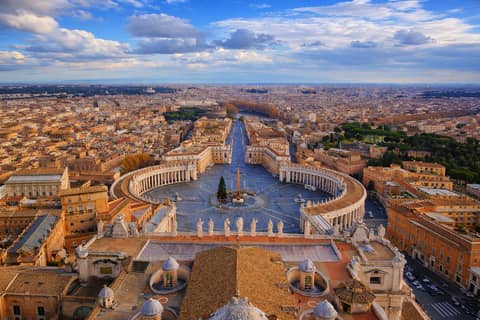
The capital of Vatican City is Vatican City itself, since it is a city-state. Wikipedia describes it as a landlocked sovereign city-state in Southern Europe, ruled by the pope, and an enclave within the city of Rome, Italy.
None of my sources names a separate capital for the state. The name itself points to the answer. The state is called the Vatican City State, and its Italian name, Stato della Città del Vaticano, means “State of Vatican City.” A state named after a single city has nowhere else to put a capital.
A short quote from the same article sets out the basics:
“Vatican City, officially the Vatican City State, is a landlocked sovereign city-state in Southern Europe.”
That is also why the search “does the Vatican City have a capital” has no map answer. There is no second town to travel to. When people say “the Vatican,” they mean the whole state or the church authority that governs it, and the buildings you can visit are all in one small area.
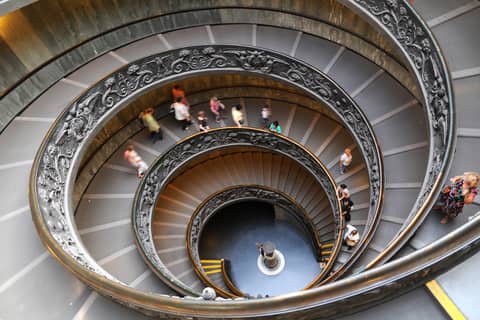 Want a closer look? Vatican: Museums & Sistine Chapel Entrance Ticket, from $36See times →
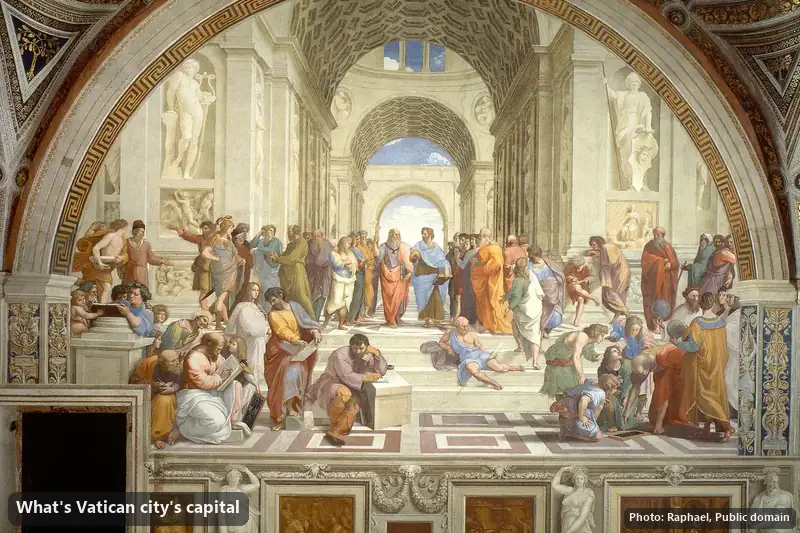
What Are the Key Facts Behind Capital Vatican City Searches?
Key facts about Vatican City cover its size, status and founding date, and the table below pulls them together from Wikipedia and Wikidata. The area and population differ a little between the two sources, so I show both.
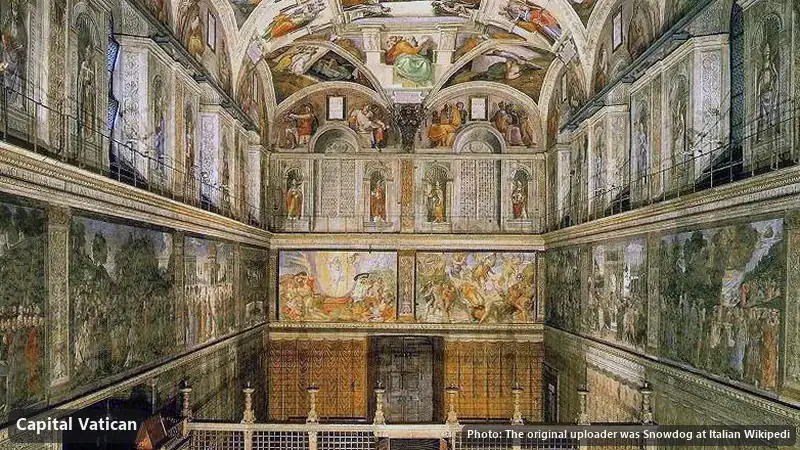 Book aheadVatican: Museums & Sistine Chapel Entrance TicketCheck availability · from $36
| Fact | Value | Source |
|---|---|---|
| Official name | Vatican City State | Wikipedia |
| Italian name | Stato della Città del Vaticano | Wikipedia |
| Latin name | Status Civitatis Vaticanae | Wikipedia |
| Area | 0.49 square kilometers (0.19 square miles) | Wikipedia |
| Area on Wikidata | 0.44 square kilometers | Wikidata |
| Population | about 882 | Wikipedia |
| Established | 11 February 1929 (Lateran Treaty) | Wikipedia and Wikidata |
| Currency | euro | Wikipedia |
| Government | absolute monarchy under the pope | Wikipedia |
Wikipedia states that Vatican City is both the smallest country by area and the least populous. Wikidata lists several population values, which shows that headcounts vary by source and date. For a place this small, a capital Vatican City map would show just one dot inside Rome. My page on where the Vatican is explains the location in more detail.
 Skip the ticket line: Rome: Vatican Museums & Sistine Chapel Skip-The-Line Ticket, from $32Check dates →
Capital Vatican City by the Numbers
Capital Vatican City figures come from Wikidata’s Vatican City entry, and each one tells you something practical:
- Area: 0.44 km², so you can cross the whole state on foot.
- Population: 949 people in 2024, which shows why there is no room for a separate capital.
- Founded: 11 February 1929, the date of the Lateran Treaty.
- Heritage status: World Heritage Site, so the whole state counts as one protected place.
- Currency: the euro, so you pay the same way as in the rest of Rome.
- Head of state: Leo XIV, the pope who rules the city-state.
 Short on time? Vatican Museums, Sistine Chapel & St. Peter's Basilica Tour, from $60Book a slot →
Who Governs Vatican City?
Vatican City is governed by the Holy See, with the pope ruling as head of an absolute monarchy. Wikipedia says the Holy See is the episcopal see of the Diocese of Rome and the central authority of the Catholic Church worldwide, and that it is itself a sovereign entity under international law.
The pope is elected by the College of Cardinals through conclaves, according to the same article. He delegates authority to the Pontifical Commission for Vatican City State, which acts as the state’s legislative body. On behalf of Vatican City, the Holy See maintains diplomatic relations with 180 states and is an observer state of the United Nations.
This structure is another reason the capital question feels odd. A normal country has a capital where the government sits. Here the government, the church authority and the city are one compact place. For more on how the pieces fit, my overview of Vatican City goes through the state’s structure, and the About Vatican City hub collects related guides.
 Prefer a guide? Rome: Vatican Museums, Sistine Chapel & Basilica Tour, from $71See tours →
How Did Vatican City Become a State?
Vatican City became a state in 1929 through the Lateran Treaty, which settled what Wikipedia calls the Roman question. The sequence below comes from the Wikipedia article on Vatican City.
- The Holy See first exercised temporal power over the Papal States, which formed on the Italian Peninsula with the donation of Frankish territory in 756.
- The pope returned to Rome at the end of the Avignon Papacy in 1377.
- Italian unification concluded with the capture of Rome by the Kingdom of Italy in 1870. The pope then declared himself a “prisoner in the Vatican.”
- The Roman question was settled in 1929 with the Lateran Treaty, which established the modern sovereign state.
The name has older roots. Wikipedia says “Vatican” derives from an Etruscan settlement, Vatica or Vaticum, in the area the Romans called Ager Vaticanus, which means “Vatican territory.” It describes the Ager Vaticanus as a marshy area on the west bank of the Tiber. The name Vatican City was first used in the Lateran Treaty, signed on 11 February 1929.
So the capital Vatican City story is really a story about a pope’s territory shrinking until it became one city. It started as the Papal States and ended as a state the size of a neighborhood.
 Planning ahead? Vatican Museums & Sistine Chapel Skip-the-Line Entry Ticket, from $53Check availability →
What Symbols Does Vatican City Have?
Vatican City symbols include its own flag and official anthem, according to the official Vatican City State website. The anthem is the Pontifical March by the French composer Charles Gounod, ordered by Pius XII on 16 October 1949.
The same page says the previous official anthem dates from 1857 and was composed by Viktorin Hallmayr. It describes the page as a history of the anthem, and it also mentions the dissolved Pontifical army and the Pontifical Gendarmerie. These details show that the state keeps ceremonial traditions even though its territory is tiny.
Two more facts round out the picture. Vatican City uses the euro as its official currency and issues its own euro coins, according to Wikipedia. It is also a de facto member of the Schengen Area, which matters little to a visitor except that you step in from Roman streets without a formal border crossing.
 Most booked this week: Rome: Vatican Museums, Sistine Chapel and Basilica Access, from $68See prices →
What Can You Visit in Capital Vatican City?
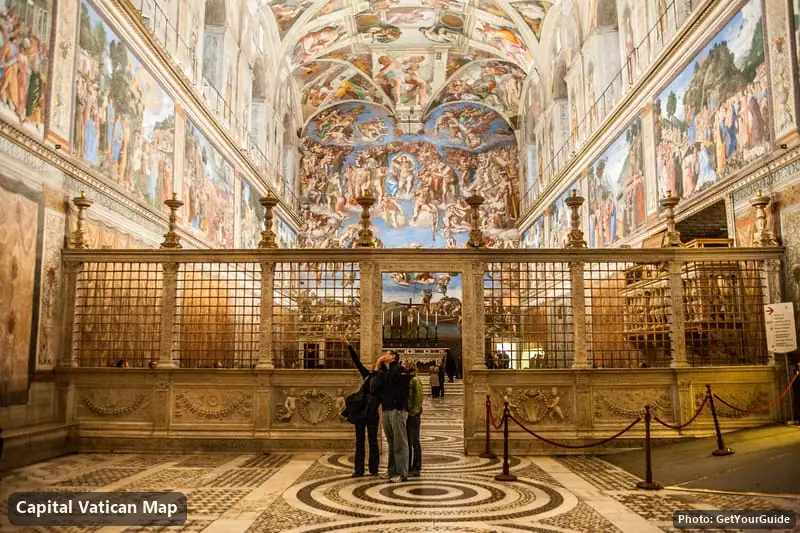
Capital Vatican City sights all sit inside the state: St. Peter’s Basilica, the Sistine Chapel, the Apostolic Palace, the Vatican Library and the Vatican Museums. Wikipedia notes that Vatican City is designated as a World Heritage Site and includes these religious, historic and cultural places.
For most visitors, three matter. The basilica sits on Piazza San Pietro, and the map listing shows it open 7 am to 7:10 pm every day. The Vatican Museums and the Sistine Chapel both list 8 am to 8 pm, Monday to Saturday, and closed on Sunday. Treat those times as approximate, and confirm hours on the official Vatican Museums site, which also shows whether the museums are open at the moment.
Saint Peter’s Basilica
Basilica · ★ 4.8 · 185,703 Google reviews
Piazza San Pietro, 00120 Città del Vaticano, Vatican City
Opening hours
- Friday7 am–7:10 pm
- Monday7 am–7:10 pm
- Saturday7 am–7:10 pm
- Sunday7 am–7:10 pm
- Thursday7 am–7:10 pm
- Tuesday7 am–7:10 pm
- Wednesday7 am–7:10 pm
Vatican Museums
Art museum · ★ 4.6 · 213,480 Google reviews
00120 Città del Vaticano, Vatican City
Opening hours
- Friday8 am–8 pm
- Monday8 am–8 pm
- Saturday8 am–8 pm
- SundayClosed
- Thursday8 am–8 pm
- Tuesday8 am–8 pm
- Wednesday8 am–8 pm
Sistine Chapel
Catholic church · ★ 4.7 · 98,723 Google reviews
00120 Città del Vaticano, Vatican City
Opening hours
- Friday8 am–8 pm
- Monday8 am–8 pm
- Saturday8 am–8 pm
- SundayClosed
- Thursday8 am–8 pm
- Tuesday8 am–8 pm
- Wednesday8 am–8 pm
Ristorante Pizzeria Castello
Pizza restaurant · ★ 4.7 · 18,643 Google reviews
Via delle Fornaci, 27, 00165 Roma RM, Italy
Opening hours
- Friday11 am–11 pm
- Monday11 am–11 pm
- Saturday11 am–11 pm
- Sunday11 am–11 pm
- Thursday11 am–11 pm
- Tuesday11 am–11 pm
- Wednesday11 am–11 pm
The pizza restaurant in that list is on Via delle Fornaci in Rome, outside the state, with daily hours of 11 am to 11 pm. It reminds you that the Vatican is small, and lunch is a short walk away. A traveler’s review of the basilica shows what the visit feels like:
“Do not miss this place for a FREE location! This is the most beautiful church I've ever been to. Once your through security and the main doors, you are truly hit by the size and artwork. We got there 645am and already there's a line but got in very quickly. If your just there for free visit, you can see most of it in 40mins. Pay extra for the other locations.”
My page on St. Peter’s Basilica goes deeper on the church itself.
Best value pick: Vatican: Museums & Sistine Chapel Entrance Ticket, from $36View dates →How Do You Visit Capital Vatican City Sights With a Ticket?
Visiting Vatican City sights with a ticket means using a timed entry ticket or guided tour for the museums and the Sistine Chapel, while you enter the basilica separately through St. Peter’s Square. The state has no gates or capital district to pass through, so the planning is about which sight and which slot.
The tours below are listed with fixed slots and different levels of help:
Vatican: Museums & Sistine Chapel Entrance Ticket
Powered by GetYourGuide · affiliate link
Rome: Vatican Museums & Sistine Chapel Skip-The-Line Ticket
Powered by GetYourGuide · affiliate link
The first is a museums and Sistine Chapel entrance ticket listed at $36.21, which excludes a guide and says a visit to the basilica is free of charge but access is not guaranteed. The second, from Tours And Tours, is listed at $32.31. It asks you to redeem the ticket at Via Germanico 8 and arrive 15 minutes before the start time, and it warns that latecomers are not guaranteed skip-the-line entry.
If you would like a guide, these two add the basilica:
Vatican Museums, Sistine Chapel & St. Peter's Basilica Tour
Powered by GetYourGuide · affiliate link
Rome: Vatican Museums, Sistine Chapel & Basilica Tour
Powered by GetYourGuide · affiliate link
The Enjoy Rome tour is listed at $60.17 for 2 to 3 hours, and Crown Tours at $71.31 for 2 to 4 hours, with basilica and dome options on select tickets. Read each listing’s inclusions, because the basilica is optional on several of them. I’d book a timed slot rather than turn up on the day. For a full ticket breakdown, see my guide to Vatican Museum tickets.
Going with family? Rome: Vatican Museums & Sistine Chapel Skip-The-Line Ticket, from $32Compare tickets →Is There a Capital One Angle to Vatican Tickets?
Capital One and Vatican tickets come up when some searchers pair the word capital with a card brand while planning payment. I cannot make claims about any bank or card from my sources, so I do not describe how a card works with a seller. My separate page on Vatican tickets and Capital One payment covers that question.
What I can say is general. Tickets sold by the official museums site and by seller platforms are separate products, so check who you are paying and what the confirmation says. Ticket prices and rules change, so confirm them on the official site before you buy.
Want a closer look? Vatican Museums, Sistine Chapel & St. Peter's Basilica Tour, from $60See times →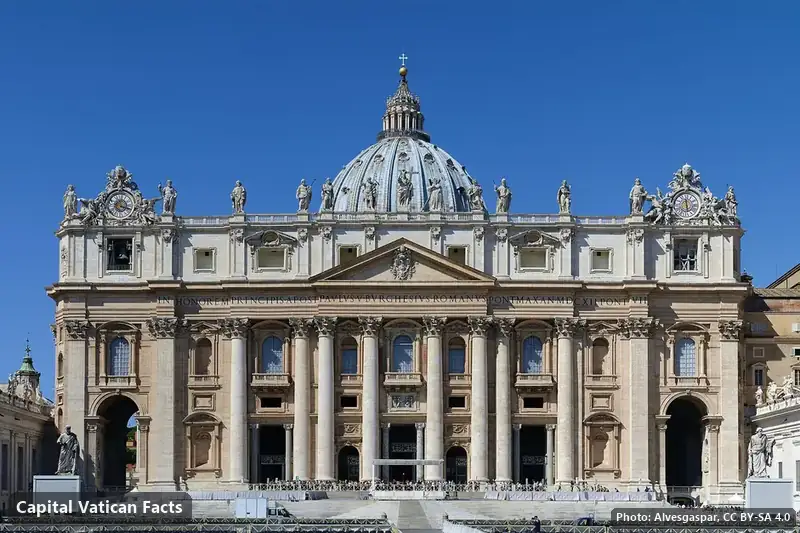
Is Vatican City a Real City, and Why Is It So Small?
Vatican City is a real city in name and a country in law, and it is so small because of how the 1929 settlement drew its borders. Wikipedia says the Lateran Treaty established the modern state, named after Vatican Hill, the location of the state within the city of Rome.
The article also notes that the term Vaticanus narrowed over time. In the first century AD it came to denote a much more restricted area than the old Ager Vaticanus: the Vatican Hill, today’s St. Peter’s Square and possibly today’s Via della Conciliazione. That helps explain why the modern state is centered on the hill and the square rather than on a wide stretch of land.
Its small size has a practical effect for a visitor to capital Vatican City. You do not need a car or a day of travel to cross it. Most people walk between the basilica and the museum side, though the two have separate entrances and are separate visits. Wikidata also lists its coordinates as about 41.904 north and 12.453 east, so a capital Vatican City map is a single point inside Rome.
Skip the ticket line: Rome: Vatican Museums, Sistine Chapel & Basilica Tour, from $71Check dates →What Do Visitors Say About Capital Vatican City Sights?
Visitor reviews of Vatican sights are strongly positive, though some travelers ask for clearer directions. The map listings show the Vatican Museums at 4.6 stars from about 213,000 reviews, St. Peter’s Basilica at 4.8 stars from about 186,000 reviews and the Sistine Chapel at 4.7 stars from about 99,000 reviews.
The tour listings tell a similar story. The museums entrance ticket is listed at 4.48 stars across 160,009 reviews, and the Crown Tours option at 4.65 stars across 19,481 reviews. Across those listings, travelers praise skip-the-line access and knowledgeable guides, and some ask for clearer information on queues and arrival times.
One reviewer who could not use a guide did the visit alone with an audio guide:
“We were unable to do this with a guide due to my child being in a wheelchair. We did the tour on our own with an audio guide. The Vatican was beautiful and we did get to see most of the sights”
That is a useful reminder that the same small state can be visited in more than one way. The best choice depends on your group, your pace and how much you want explained, and a booked slot with a clear meeting point removes most of the stress.
Short on time? Vatican Museums & Sistine Chapel Skip-the-Line Entry Ticket, from $53Book a slot →Your Capital Vatican City Questions Answered in Brief
Capital Vatican City in brief: it is a city-state with no separate capital, governed by the Holy See and ruled by the pope. Visiting it means choosing which sights to see and booking a slot.
Keep these points in mind:
- The answer to the capital question: the city is the state.
- The size: 0.49 square kilometers, the smallest country by area.
- The founding: the Lateran Treaty of 11 February 1929.
- The main sights: the basilica, the museums, the Sistine Chapel, the Apostolic Palace and the library.
- The practical step: book a timed slot and check the official hours.
For wider background, my Vatican overview ties these facts together, and the Online Vatican Tickets shows every ticket type. Once you know that capital Vatican City is a single small place, planning a visit gets much simpler.
Prefer a guide? Rome: Vatican Museums, Sistine Chapel and Basilica Access, from $68See tours →Top-rated Vatican tickets and tours
Vatican: Museums & Sistine Chapel Entrance Ticket
Powered by GetYourGuide · affiliate link
Rome: Vatican Museums & Sistine Chapel Skip-The-Line Ticket
Powered by GetYourGuide · affiliate link
Vatican Museums, Sistine Chapel & St. Peter's Basilica Tour
Powered by GetYourGuide · affiliate link
Frequently asked questions
Where is Vatican City located?
Vatican City is a landlocked sovereign city-state in Southern Europe. It is an enclave within the city of Rome, Italy, and Wikidata gives its coordinates as about 41.904 north and 12.453 east.
What is the official website for buying tickets to the Vatican museums?
The Vatican Museums run their own official site, which is the place to start for tickets and opening hours. Seller platforms such as GetYourGuide also list timed entry, but they are separate from the official site.
Does Vatican City have its own army?
The official Vatican City State website refers to the dissolved Pontifical army of the past, so the old army is not current. I have no source on present-day security arrangements, so I won't describe them.
Can you take photos in Vatican City?
The sources behind this guide do not list photo rules, so I won't guess. Rules can differ between the basilica, the museums and the Sistine Chapel, so check the official sites and signs at each entrance.
Is Vatican City a country?
Yes. Wikipedia calls it a sovereign city-state, and the official Vatican City State website describes it as a universally recognized sovereign entity under international law. It is the smallest country by area and the least populous.
Keep planning your visit
More About Vatican City guides
Online Vatican Tickets is an independent visitor guide. Prices and hours change: check the official Vatican Museums website before you go. Tour links are GetYourGuide affiliate links.